

In homoeopathy, the first prescription is often considered only the beginning of the therapeutic journey. The real challenge may come during the follow-up consultation, when the practitioner must decide whether to wait, repeat, change, or reassess the prescription.
This stage is traditionally referred to as the “second prescription.” It is an important concept in classical homoeopathic practice, but it is also one of the most misunderstood areas of homoeopathic case management.
A second prescription should not simply mean giving another medicine because the patient has returned. It involves careful observation of the patient’s progress, changes in symptoms, new developments, and the overall clinical picture.
It is also important to distinguish traditional homoeopathic practice from scientific evidence. Current evidence does not establish homoeopathy as an effective treatment for specific medical conditions, so patients should not delay or replace appropriate evidence-based medical care with homoeopathy.
What Is the Second Prescription in Homoeopathy?
The second prescription in homoeopathy refers to the clinical decision made during a follow-up after the initial prescription.
After the first prescription, the practitioner observes:
- What has changed?
- Which symptoms have improved?
- Which symptoms remain?
- Have new symptoms appeared?
- Has the patient’s general health changed?
- Is the original symptom pattern still present?
- Is further treatment actually necessary?
The second prescription is therefore traditionally viewed as an assessment of response, rather than simply a second dose of medicine.
Why Is the Second Prescription Important?
The first consultation provides a picture of the patient’s condition at that particular time.
But health conditions can change.
A patient may:
- Improve significantly.
- Improve partially.
- Remain unchanged.
- Develop new symptoms.
- Experience worsening symptoms.
- Develop symptoms that require conventional medical investigation.
For this reason, homoeopathic follow-up care requires observation and clinical judgment.
The practitioner should not assume that the same prescription must automatically be repeated at every visit.
The Principle of “Wait and Watch”
One of the commonly discussed ideas in classical homoeopathic practice is that a practitioner should sometimes wait and observe rather than immediately prescribe again.
If a patient is improving, changing the prescription too quickly may make it difficult to understand what is happening.
A follow-up assessment may therefore ask:
Is the patient improving?
If symptoms are improving and there are no concerning developments, the practitioner may traditionally choose observation rather than immediately changing the prescription.
Is there no meaningful change?
The practitioner may need to reassess the original case and consider whether the initial assessment was complete.
Are symptoms getting worse?
Worsening symptoms should never automatically be interpreted as a “healing response.” A proper clinical assessment is needed to rule out disease progression, complications, adverse effects, or the need for urgent medical care.
What Should Be Observed Before the Second Prescription?
A professional homoeopathic consultation should involve careful follow-up rather than routine repetition.
1. Change in the Main Complaint
The practitioner should compare the current symptoms with the symptoms recorded during the first consultation.
Questions may include:
- Is the main complaint better?
- Is it less frequent?
- Is the intensity lower?
- Has the duration changed?
- Has the location changed?
2. General Well-Being
Traditional individualized homoeopathy places importance on the patient’s overall experience.
During follow-up, the practitioner may ask about:
- Energy levels
- Appetite
- Sleep
- Mood
- Daily activity
- Digestion
- General comfort
- Quality of life
These observations can provide useful information about how the patient feels over time.
3. New Symptoms
New symptoms should be assessed carefully.
A new symptom may represent:
- A change in the underlying condition
- A new illness
- A medicine-related effect
- A natural change in the disease
- A symptom requiring further investigation
It should not automatically be labelled as part of a homoeopathic response.
The Second Prescription Is Not Simply “Another Prescription”
This is one of the most important points.
A common misunderstanding is:
First prescription → patient returns → give another remedy.
This is not a thoughtful follow-up process.
The second prescription traditionally involves clinical observation and reassessment.
The practitioner should ask:
“What has changed since the last consultation?”
rather than:
“Which medicine should I prescribe next?”
This change in thinking can make follow-up consultations more structured and patient-focused.

Different Situations During Follow-Up
When the Patient Is Improving
If the patient reports meaningful improvement, the practitioner may focus on observation and continued monitoring rather than automatically changing treatment.
This is traditionally described as allowing the existing prescription to act.
From a modern medical perspective, however, improvement should be assessed objectively where possible and appropriate.
When the Patient Has Improved but Symptoms Remain
Partial improvement may require a detailed reassessment.
The practitioner may review:
- The original symptoms
- Current symptoms
- Treatment history
- Lifestyle factors
- Possible triggers
- New medical findings
- Relevant diagnostic reports
This is an important part of personalized homoeopathic care.
When the Patient Has Not Improved
Lack of improvement should prompt reassessment.
The practitioner should consider whether:
- The diagnosis needs review.
- Further investigations are needed.
- The condition requires another specialist.
- The original symptoms were interpreted incorrectly.
- There are lifestyle or environmental factors involved.
- Conventional treatment is required.
A lack of response should not automatically lead to repeated changes in homoeopathic medicines.
When the Patient Is Getting Worse
Worsening symptoms require particular attention.
The practitioner should consider whether the patient needs:
- Physical examination
- Laboratory investigations
- Imaging
- Specialist consultation
- Emergency treatment
Patient safety must always come first.
The Importance of Case Reassessment
A detailed homoeopathic case analysis should not end after the first prescription.
At follow-up, the practitioner can compare:
Before treatment
- Main symptoms
- Frequency
- Severity
- Triggers
- Associated symptoms
- General health
After treatment
- Symptom changes
- New complaints
- Frequency and intensity
- Daily functioning
- Sleep and appetite
- Relevant clinical findings
This comparison provides a clearer picture of what has changed.
Second Prescription and Individualized Homoeopathy
One of the central ideas of traditional homoeopathic practice is individualized treatment.
Different patients with the same diagnosis may describe their symptoms differently.
For example, two people with the same medical diagnosis may have different:
- Triggers
- Symptom patterns
- Sleep patterns
- Appetite
- Associated symptoms
- Lifestyle factors
- Treatment histories
Traditional homoeopathic practice may therefore use an individualized approach.
However, the existence of individualized prescribing does not itself prove that homoeopathic medicines are clinically effective. Current scientific reviews have found little reliable evidence that homoeopathy is effective for any specific health condition.
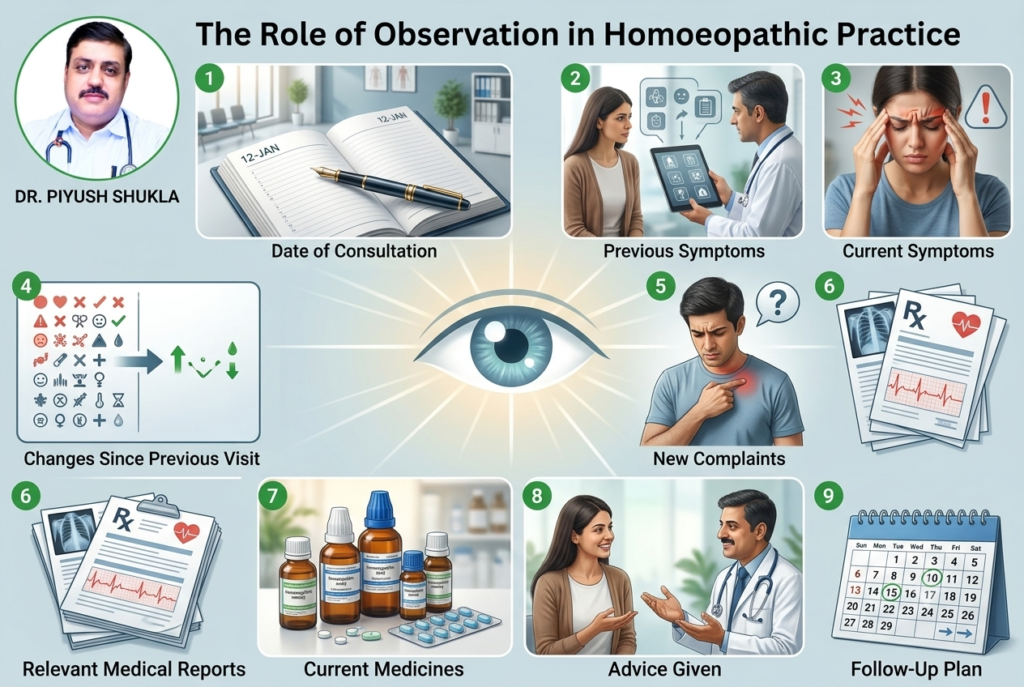
The Role of Observation in Homoeopathic Practice
Observation is an important part of responsible healthcare.
A good follow-up should document what happened rather than relying only on assumptions.
Useful documentation may include:
- Date of consultation
- Previous symptoms
- Current symptoms
- Changes since the previous visit
- New complaints
- Relevant medical reports
- Current medicines
- Advice given
- Follow-up plan
This creates better continuity of care.
Common Mistakes in the Second Prescription
1. Repeating the Same Medicine Automatically
A medicine should not be repeated simply because the patient has returned.
The current clinical picture should be reviewed first.
2. Changing the Medicine Too Quickly
Frequent changes can make it difficult to understand whether there has been any meaningful change in symptoms.
3. Ignoring New Symptoms
New or unusual symptoms deserve proper assessment.
4. Assuming Every Worsening Is a “Healing Crisis”
This can be dangerous.
Worsening symptoms may indicate disease progression or another medical problem. They should be evaluated appropriately.
5. Ignoring Conventional Diagnosis
Patients should not avoid diagnostic testing or medical treatment because they are receiving complementary care.
How Homoeopathy Can Help in Follow-Up Care
From the perspective of traditional practice, a homoeopathic doctor may use follow-up consultations to:
- Review changes in symptoms
- Understand the patient’s current health status
- Record treatment response
- Reassess the case
- Discuss lifestyle factors
- Monitor long-term concerns
- Decide whether another consultation is needed
This can support a structured patient-centered care approach.
However, homoeopathy should not be presented as a proven treatment for diseases where reliable evidence is lacking. Patients should continue appropriate medical care and discuss complementary approaches with their healthcare professionals.
Can the Second Prescription Prevent Disease?
The second prescription itself should not be described as a method of preventing disease.
There is no reliable scientific evidence that homoeopathic medicines can prevent specific diseases.
Instead, prevention should focus on established measures such as:
- Vaccination where recommended
- Healthy nutrition
- Regular physical activity
- Good sleep
- Hygiene
- Avoiding tobacco
- Appropriate screening
- Managing known risk factors
- Timely medical consultation
A responsible homoeopathic clinic can contribute to health education and encourage patients to seek appropriate preventive and medical care.
When Should a Patient Seek Conventional Medical Care?
A follow-up appointment should never delay urgent treatment.
Patients should seek prompt medical attention for symptoms such as:
- Severe chest pain
- Difficulty breathing
- Sudden weakness
- Loss of consciousness
- Severe bleeding
- Persistent high fever
- Severe abdominal pain
- Sudden neurological symptoms
- Rapid deterioration
The role of any trusted homoeopathic care provider should include recognizing situations where referral or emergency treatment is necessary.
Second Prescription in the Modern Healthcare Setting
Modern healthcare increasingly focuses on:
Assessment → Treatment → Monitoring → Review → Adjustment
This is not limited to one medical system.
The broader principle is useful: treatment decisions should be based on what happens to the patient over time.
For a professional homoeopathic consultation, this means maintaining good records, reviewing symptoms carefully, communicating clearly, and recognizing when conventional investigation or treatment is needed.

Telemedicine and the Second Prescription
The growth of online homoeopathy consultation has made follow-up communication easier for many patients.
Selected follow-up discussions may be conducted through:
- Video consultation
- Telephone consultation
- Secure digital communication
- Review of medical reports
- Digital health records
However, telemedicine has limitations. A physical examination or urgent in-person assessment may be necessary for some symptoms.
An online follow-up should therefore never be used to delay emergency medical care.
How to Make a Homoeopathic Follow-Up More Effective
For Patients
Before a follow-up appointment, patients can note:
- Which symptoms improved
- Which symptoms remained
- Which symptoms became worse
- Any new symptoms
- Changes in sleep
- Changes in appetite
- Changes in energy
- Current medicines
- New medical reports
This makes the homoeopathy follow-up consultation more informative.
For Practitioners
Practitioners should:
- Review the previous case.
- Compare old and new symptoms.
- Record objective findings when available.
- Avoid automatic prescription changes.
- Recognize red flags.
- Refer when necessary.
- Explain treatment decisions clearly.
- Respect evidence-based medical care.

The Second Prescription as an Art of Observation
The phrase “second prescription” is often described as an art because it requires careful observation and judgment within traditional homoeopathic practice.
But good healthcare should not depend only on intuition.
A responsible approach combines:
Careful observation + Good documentation + Clinical judgment + Patient communication + Appropriate medical referral
This makes follow-up more structured and safer.
The Role of Dr. Piyush Homoeopathy
At Dr. Piyush Homoeopathy, a patient-focused consultation can emphasize detailed history-taking, symptom review, follow-up communication, and individualized attention.
For patients using complementary homoeopathic care, the focus should remain on responsible healthcare, clear communication, and timely medical referral whenever required.
Patients should always share their complete medical history, current medicines, and relevant reports during consultation.
Key Takeaways
- The second prescription in homoeopathy traditionally refers to the treatment decision made after observing a patient’s response to the initial prescription.
- A follow-up should begin with careful observation and reassessment, not automatic repetition of a medicine.
- Changes in symptoms, general health, new complaints, and relevant medical findings should be documented.
- Worsening symptoms should not automatically be considered a “healing response”; appropriate medical assessment is important.
- Individualized homoeopathic care can emphasize detailed follow-up and patient communication, but scientific evidence does not establish homoeopathy as an effective treatment for specific diseases.
- Responsible healthcare means knowing when complementary care is appropriate and when conventional diagnosis, treatment, specialist care, or emergency attention is necessary.